Phone:
(853) 6325-0984
Email Address:
t58609983@gmail.com

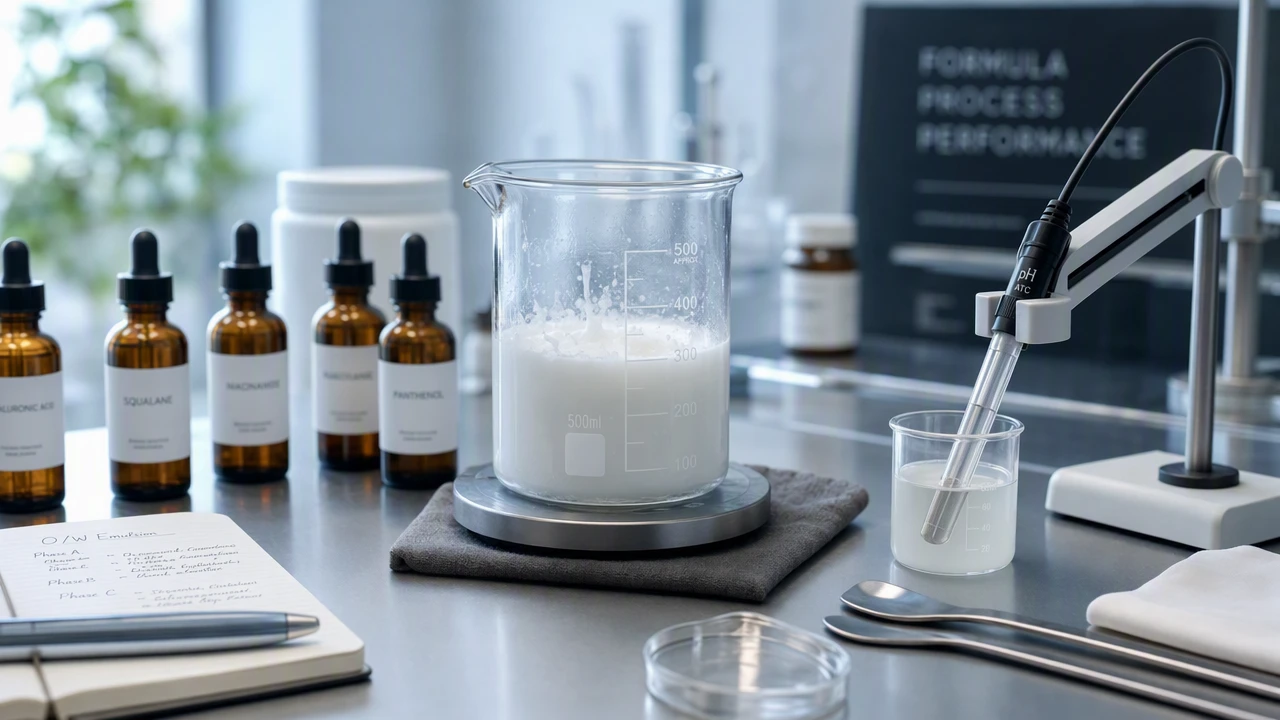
A formulator can source a well-characterized peptide, pay a premium for purity, dose it at the level the supplier's data supports, and still ship a product that does nothing measurable. The peptide is rarely the failure point. The failure point is usually the twenty minutes between weighing it out and sealing the batch, plus the pH the rest of the formula happens to land on. Peptides are short amino acid chains with reactive bonds and, in many cases, coordinated metal centers. Everything else in the beaker is either protecting that structure or slowly taking it apart.
Three mechanisms account for most of the loss you will see in a peptide formula, and each one maps to a different formulation decision.
Hydrolysis and deamidation attack the peptide backbone and specific residues under acidic conditions. Most cosmetic peptides are reported to hold up in the pH 5.0–7.0 range, and formulations below roughly pH 4.5 carry real risk of both pathways. This is a chemical reality of the molecule, not a marketing threshold, and it does not care how elegant the rest of the formula is.
Aggregation and precipitation are the second route. Peptides can clump into larger complexes that no longer penetrate the skin effectively, which means a formula can lose function while still passing a visual inspection. Concentration, ionic environment, and how the peptide is introduced into the batch all feed into this.
Metal-complex dissociation is the third, and it applies specifically to copper peptides. Copper-tripeptide activity depends on the metal staying coordinated to the ligand, and copper ions dissociate from the complex below about pH 5.0. The stability of such complexes is described by pH-dependent stability constants, which is a compact way of saying the same peptide is a different molecule at pH 4.8 than at pH 6.2. Copper peptides therefore have a narrower operating window than the general peptide guidance suggests.
The most common process error is treating pH as a step near the end of the batch record. In a peptide formula, pH determines which peptides you are allowed to use, which co-actives can share the same phase, and whether the preservative system you prefer will function at all. It should be fixed before the ingredient list is finalized.
Work backward. Choose the target pH from the peptide's stability window first, verify that your preservative system is effective in that window, and only then decide which secondary actives can be accommodated. If a co-active forces the batch below the peptide's tolerance, the co-active moves out of the formula, not the pH.
This is where low-pH systems create the sharpest conflict. Ascorbic acid and exfoliating acids depend on an acidic environment for their own performance, which puts them in direct opposition to the peptide's requirement. There is no clever adjustment that satisfies both. The honest options are separating them into different products, separating them into different steps in a routine, or using a two-part system where the phases meet on the skin rather than in the bottle. Compromising to a middle pH generally produces a formula in which neither active performs.
Peptide degradation from heat is process damage, and it is fully avoidable. Peptides should be added after emulsification, at or below 40°C. High-shear mixing at elevated temperature will destroy most peptide actives, so the peptide must never be present during the hot phase or during the high-energy homogenization step.
That constraint shapes the whole manufacturing sequence:
Scale-up is where this breaks quietly. A lab batch cools in minutes; a production vessel does not. The batch record needs an explicit temperature gate before peptide addition, not a step that says "cool phase."
Chelating agents are standard in aqueous cosmetics for a reason: sequestering trace metal ions supports preservation and limits oxidation of other components. For metal-dependent peptides, that same function is a liability. A chelator competing for copper is competing with the peptide ligand for the ion that makes the peptide active, and the outcome depends on relative binding affinities in your specific system rather than on a general rule.
Practically, this means copper-peptide formulas need their metal balance treated as a design constraint. Reduce reliance on chelation for oxidative control where possible, lean on packaging and formula simplicity instead, and treat any chelator addition as something to be evaluated by stability testing rather than assumed harmless. For non-metal peptides, the conflict largely disappears and the usual preservation logic applies.
Once pH and process are locked, co-active selection becomes a short set of decisions rather than an open question.
| Co-active | Primary conflict | Formulation approach |
|---|---|---|
| Niacinamide, hyaluronic acid, ceramides | Generally compatible with peptides | Combine in the cool phase; confirm final pH stays in range |
| Low-pH acids | pH incompatibility with peptide stability | Separate product or separate routine step |
| Ascorbic acid systems | Requires acidic environment the peptide cannot tolerate | Separate product, separate step, or two-part system |
| Chelating agents (copper peptides) | Competition for the coordinated metal ion | Minimize, justify, and verify with stability testing |
The value of writing it out this way is that it forces you to say which active is the formula's lead. A peptide serum built around a peptide should be optimized for the peptide. A vitamin C serum with a peptide added for label appeal is a vitamin C serum with a degraded peptide in it.
When the formulation constraints are too tight, the answer is sometimes to change the molecule rather than the formula. Chemical modification strategies used in cosmetic peptide synthesis include acetylation, amidation, and palmitoylation, and modification is applied specifically to improve stability, solubility, and formulation compatibility. Review evidence points the same direction: a succinyl-conjugated peptide showed higher stability than the unconjugated peptide, which was offered as part of the explanation for its observed performance.
Delivery systems address both stability and the separate problem that most cosmetic peptides exceed 500 Da and are hydrophilic, making stratum corneum penetration the primary efficacy bottleneck. Lipid conjugation, liposomes, and nanoemulsions are used to improve bioavailability, and a 2024 liposomal study reported improved stability relative to an open-formulation peptide, suggesting encapsulation can partly resolve the compatibility problem rather than just the penetration one. Encapsulation is not free — it changes cost, texture, and process — but it is a legitimate alternative to endlessly negotiating with an incompatible base.
Peptide attributes are affected by interactions with other components, pH, temperature, and formulation processes including encapsulation, packaging, and concentration. Packaging belongs in that list, not after it. Light and oxygen exposure, repeated air ingress from a dip-in jar, and warm bathroom storage all continue the degradation the formula was designed to prevent, and they operate for the entire shelf life rather than for one processing step. Some peptide products are handled with refrigeration for this reason. If a formula is only stable under conditions the consumer will not maintain, the specification is unrealistic and belongs back in development.
Set target pH from the peptide's stability window before selecting co-actives. Verify preservative efficacy at that pH. Confirm whether the peptide is metal-dependent, because that narrows the window and constrains chelation. Design the process so the peptide enters only after emulsification and high-shear work, at or below 40°C, pre-dissolved and gently mixed. Assign every remaining active to either the same product or a separate one based on pH compatibility, not on how good it looks on the front label. Then choose packaging that maintains those conditions through use, and let stability testing confirm the decisions rather than validate assumptions.
Peptide selection is the part of this work that gets discussed most and matters least once you are above a reasonable purity baseline. Sequence, pH, temperature, and the metal environment are what determine whether the peptide you paid for is still the peptide the consumer applies.