Phone:
(853) 6325-0984
Email Address:
t58609983@gmail.com

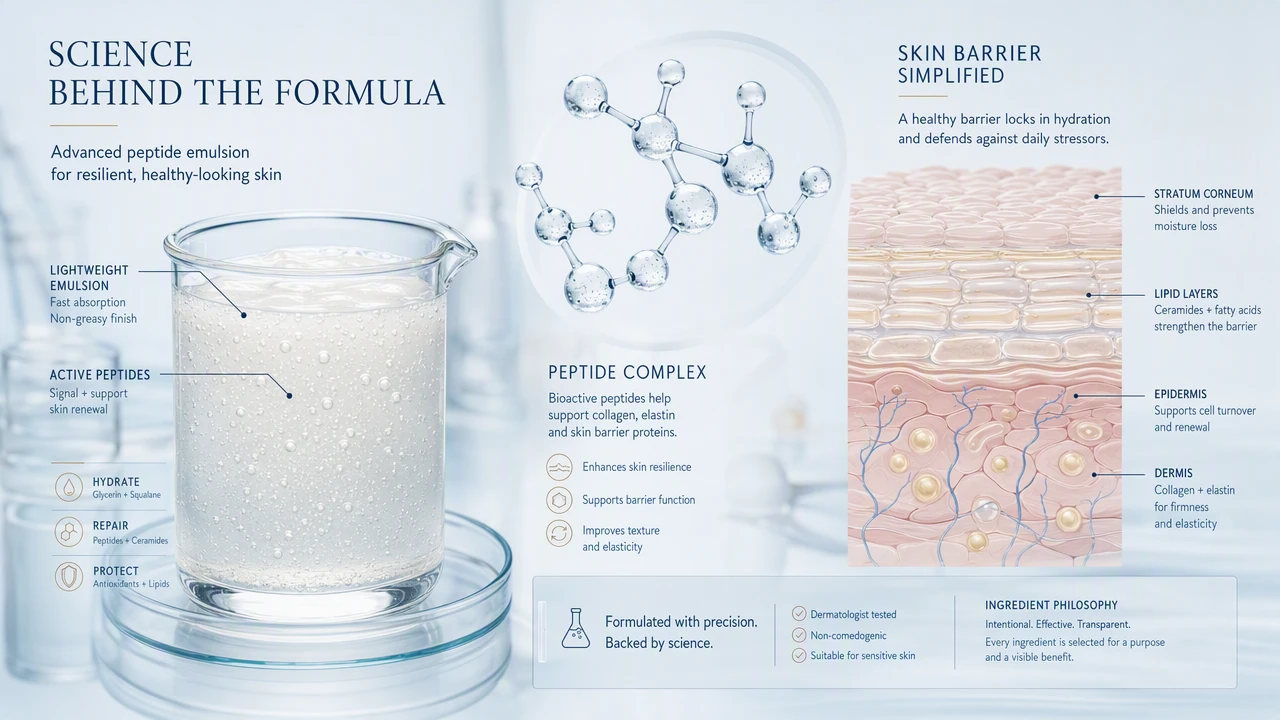
Acetyl Hexapeptide-8 (AH-8) is a useful case study in how an ingredient can become broadly familiar in cosmetic formulations while key questions about topical delivery and real-world efficacy remain difficult to answer. For formulators and reviewers, the central issue is not whether the peptide has a plausible biological rationale, but whether a finished topical system can place a meaningful amount of intact peptide at the relevant skin site and support a benefit that is distinguishable from the rest of the formula.
AH-8 is a hydrophilic peptide with a relatively large molecular size for passive topical transport. Those properties work against easy passage through the stratum corneum, the outer barrier layer that limits the entry of many water-soluble actives. A cited skin-penetration study found that topical delivery of AH-8 has been sparsely studied and remains controversial, despite the ingredient’s presence in a wide range of anti-aging products.
This does not mean that an AH-8-containing product cannot have a cosmetic effect. It means that a claim about the peptide itself requires more than evidence that the peptide is present on an ingredient list. A formula may improve the appearance or feel of skin through hydration, film formation, emolliency, or other actives even when delivery of the peptide into deeper viable skin layers is limited.
The available review literature frames permeability as a formulation-dependent question. Penetration can be influenced by the peptide’s physicochemical properties, emulsion type and internal structure, the condition and anatomical site of the skin, application area and duration, and skin metabolism. These variables make it risky to transfer a result from one vehicle directly to another.
For AH-8, the delivery system should be treated as part of the ingredient assessment rather than as a neutral carrier. A simple comparison between two formulas containing the same named peptide may reveal very little if their emulsion structures, solvent environments, deposition behavior, or barrier interactions differ.
An evaluator should first establish what the test actually measures. Surface deposition, retention in the stratum corneum, movement into viable epidermis, and transdermal passage are different outcomes. They answer different questions and should not be presented as interchangeable evidence of efficacy.
This distinction is especially important when a study uses a delivery-enhancing format. A result obtained with a specialized system may show that the system changes access to the skin; it does not automatically establish the same performance for a conventional serum, cream, or gel. Likewise, evidence from a patch or device-assisted application should not be generalized to ordinary leave-on use without direct support.
AH-8 concentration is often treated as if it were a direct proxy for strength. In practice, the declared use level is only one input in a much larger chain. The amount applied, the stability of the peptide in the formulation, distribution within the vehicle, release at the skin surface, and actual retention or penetration all affect exposure.
For formulation development, concentration should therefore be discussed alongside the following questions:
A higher concentration may increase the amount available at the surface, but it does not resolve a permeability limitation by itself. Conversely, an apparently modest level in a well-characterized vehicle may be more informative than a larger nominal dose in a poorly defined system. The reviewer’s job is to separate label-level concentration from demonstrated delivered exposure.
AH-8 is commonly associated with expression-line and wrinkle-focused cosmetic positioning. The proposed rationale is generally linked to a biomimetic peptide approach: peptides are designed to resemble or influence signaling processes relevant to skin homeostasis, repair, or regeneration. That rationale can justify further investigation, but it is not equivalent to proof of a visible outcome in a finished product.
A strong efficacy review should ask whether the reported benefit comes from an appropriate study design and whether the tested material resembles the formula being evaluated. Results from an isolated ingredient, a specialized carrier system, or a multi-ingredient preparation answer different questions. If a formula contains moisturizers, polymers, botanical extracts, or other anti-aging actives, an observed appearance change may not be attributable to AH-8 alone.
The evidence also needs to match the claim language. A short-term smoothing appearance, a reduction in the visual prominence of lines, and a structural skin-remodeling claim are not the same proposition. Cosmetic communication should remain anchored to what the study endpoint can actually support.
AH-8 illustrates a repeatable evaluation workflow for peptide ingredients.
Begin with identity and quality. Confirm the peptide sequence, acetylation state where relevant, purity specification, assay approach, and batch-to-batch controls. A peptide name alone does not describe the quality of the material used in a test or commercial formula.
Then assess formulation compatibility. Consider the vehicle, pH environment, processing conditions, interactions with other ingredients, and the likelihood that the peptide remains intact for the claimed shelf life. A biologically interesting peptide is not automatically a robust cosmetic raw material.
Next, review delivery evidence with precision. Identify the skin model, application conditions, duration, analytical method, and skin layer measured. Give more weight to evidence that connects the actual formulation to peptide deposition or retention in a relevant compartment.
Finally, review efficacy evidence separately from delivery evidence. Ask whether the tested formula is comparable to the intended product, whether the endpoint is suitable for the claim, whether comparison conditions are meaningful, and whether the study design can distinguish the peptide’s contribution from the base formulation.
AH-8 should not be judged solely by its long-standing cosmetic presence or by a mechanism described in broad terms. Its profile instead reinforces a practical rule for peptide assessment: plausibility, formulation delivery, and finished-product efficacy are separate evidence layers.
When those layers are reviewed independently, the discussion becomes more useful. The formulator can identify where delivery work is needed, the quality team can define meaningful specifications, and the claim reviewer can avoid overstating what a nominal peptide concentration proves. For AH-8 and other cosmetic peptides, that disciplined separation is often more valuable than a simple yes-or-no verdict on whether an ingredient “works.”